Support WBUR
A stress test for the midterms
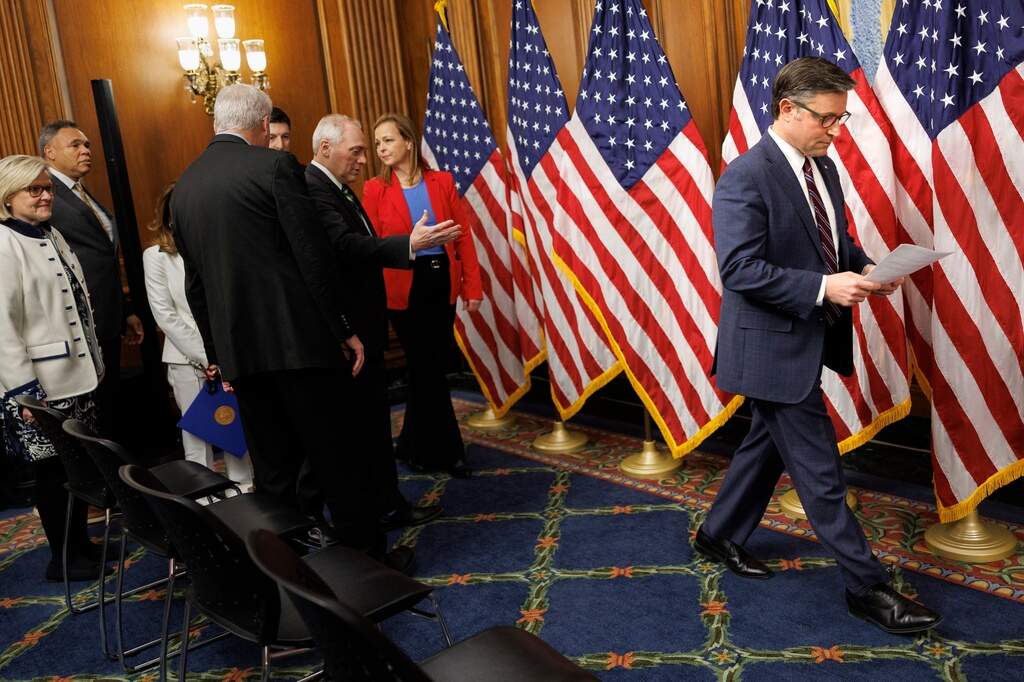
President Trump wants congress to pass the SAVE Act, requiring would-be voters to prove they are citizens. He’s called for Republicans to nationalize voting and even mused that the midterms should be canceled. What that all means for the midterms.
Guests
Michael McNulty, Policy Director at Issue One (bipartisan think tank).
Also Featured
Justin Roebuck, chief election officer for Ottawa County, Michigan.
Omar Sabir, chair of the Philadelphia Election Board.
The version of our broadcast available at the top of this page and via podcast apps is a condensed version of the full show. You can listen to the full, unedited broadcast here:
Transcript
Part I
MEGHNA CHAKRABARTI: The midterm elections are months away, but they're already the focus of attention for both Republicans and Democrats. The most recent polling across more than a dozen polling firms shows Americans favoring Democrats by anywhere from a +1 to a +9-point margin, President Trump's approval ratings continue to drop down to 39% according to a new ABC news poll. That means 60% of Americans polled by ABC disapprove of the president, leading to a net negative rating for President Trump of negative 21 points.
Now polls are merely a snapshot of a moment in time. So the midterms are nine months away, meaning obviously everything could change between now and then, but numbers and national sentiment are worrying enough for Republicans that they're speaking openly about their plans for the midterms. Here's President Trump speaking to House Republicans in January.
DONALD TRUMP: We had the worst president, did the worst job. They had the worst policy, we have to even run against these people. Now, I won't say cancel the election. They should cancel the election because the fake news will say he wants the elections canceled. He's a dictator. They always call me a dictator.
CHAKRABARTI: This month the president went on Dan Bongino's podcast.
Bongino is a longtime conservative podcaster and was Trump's FBI Deputy Director from 2025 to the beginning of this year, the president repeated the falsehood that Democrats are allowing undocumented migrants to vote.
TRUMP: These people were brought to our country to vote and they vote illegally. And the, amazing that the Republicans aren't tougher on it.
The Republicans should say, we want to take over, we should take over the voting. The voting in at least many, 15 places the Republicans ought to nationalize the voting.
CHAKRABARTI: Now, to be clear, the federal government does not have the power to nationalize elections. The Constitution conveys power to run elections exclusively to the states.
And also, I should say that in the federal law explicitly prohibits non-citizens from voting in federal elections. At the local level, not at the state level, but at the local level in some places, some municipalities allow non-citizen voting, say, in California, Maryland, Washington, D.C. and Vermont.
Okay. But back at the federal level, again, you heard the president just a minute ago saying that quote, these people were brought to our country to vote and they vote illegally.
At the federal level, a study by the Brennan Center for Justice looked at 42 jurisdictions with high immigrant populations, and they found that in the 2016 election just 30 votes ... were cast by non-citizens, and that's out of 23.5 million cast in those jurisdictions for a non-citizen voting rate of 0.001%. Okay. Back to what's happening now. Just last week while promoting the Congressional SAVE Act, Homeland Security Secretary Kristi Noem said this.
KRISTI NOEM: And elections is another one of those critical infrastructure responsibilities that I have as well.
And I would say that many people believe that it may be one of the most important things that we need to make sure we trust, is reliable, and that when it gets to election day, that we've been proactive to make sure that we have the right people voting, electing the right leaders to lead this country.
And Steve Bannon, former White House strategist and conservative influencer, said this on his podcast earlier this month.
STEVE BANNON: You're damn right. We're going to have ICE surround the polls come November. We're not going to sit here and allow you to steal the country again. And you can throw, you can whine and cry and throw your toys outta the pram all you want, but we will never again allow an election to be stolen.
CHAKRABARTI: Now federal law prohibits the president from deploying military troops at election sites, and in many states, it is illegal to carry a firearm near a polling place. Now, it's not just what's being said, but what's being done by Republicans and also by Democrats ahead of the midterms that we want to look at today. And to do we're going to speak with Michael McNulty. He's policy director at Issue One, which is a bipartisan think tank. And prior to that, he served as a senior Elections Advisor in the U.S. Agency for International Development, or USAID, where he led election and democracy efforts across Africa, Asia, Eastern Europe, Eurasia, and Latin America.
Michael McNulty, welcome to On Point.
MICHAEL MCNULTY: Thanks, Meghna. Thanks for having me on.
CHAKRABARTI: Okay, let's start with the big picture. And I do actually want you to compare elections here in the United States to some of the places you've been. We're not talking about a completely failed or fragile election system in the U.S now ahead of the 2026 elections.
Are we?
McNULTY: Exactly. Our guardrails are being tested, but if we were looking at it like maybe a medical patient and if I were a doctor of elections, speaking comparatively about how we compare, I would say we have a very resilient patient with a very strong immune system. We have extremely professional election administrators.
We have courts that work. We have a decentralized election system that protects against some centralized effort to nationalize or steer the elections one way or another. The thing is, normally the executive branch plays a supporting role in keeping that system healthy, like taking vitamins or having a stronger immune system.
The problem now is that the biggest stress point on this patient, the election system, is now coming from the executive branch, which is acting more like a virus rather than protecting the immune response. So like you said, I've worked all around the world for a couple decades and saw the authoritarian playbook play out in different environments.
We've seen that playbook evolve over the last couple decades, where it essentially, the takeover of elections happens through a series of small actions, well before voters cast their ballots. And so that's where I'm seeing some very familiar patterns by the current Trump administration compared to those efforts.
It's a bit clumsier than those efforts. And it also faces a much more stiff, resilient election system than I've seen in other countries. But we should make no mistake, it is a very determined effort to tilt the playing field and nationalize elections. So I would break that down looking at this playbook and comparatively how it's being enacted here.
CHAKRABARTI: Okay. So that's what we're going to do, too. But first of all, clumsier here than in other places. Authoritarians in other countries are more sophisticated in how they have infiltrated the integrity of their election systems?
McNULTY: That's correct. We've seen some ham-handed attempts to break down our election system.
We've seen lawsuits by the Department of Justice against secretaries of state to get private voter data, which actually contradicts the privacy laws in those states. And already four of those lawsuits out of the 20 something have failed. We've also, in the past, seen many lawsuits brought and electoral disputes brought in 2020 elections.
I think the record was zero for 60 in those. There's a lot of clumsiness in these attempts, but again, they're very determined. So we should take them seriously.
CHAKRABARTI: Okay. That's what we're going to do throughout the remainder of this hour. And it's both obviously your knowledge of our domestic election systems as compared to international ones that makes you the perfect person to talk to today.
But I do want to make one point, I'm glad that you reminded us that, look, in the United States, especially when it comes to local election officials and state secretaries of state in each one of the 50 states, we have a very robust system full of people who believe in a healthy and functioning election system for our democracy.
And these are people in either party. But at the same time, as you said, with pressure coming from the executive nibbling around the edges, I don't think it's good enough anymore for us to say, we're not as bad as Iran, right? In terms of our election system. We don't want to say, we don't want to compare ourselves to places where elections are overtly not free and fair.
So let's talk a little bit about this. Where would you point to as the first place that virus, as you talked about, is trying to penetrate the healthy body of our U.S. election system?
McNULTY: Yeah. The first step that we're seeing and have seen over years with this administration is to prepare the ground for tilting the playing field by perpetrating false narratives, false election fraud narratives, and now in this administration, by putting election deniers in key positions in the Department of Justice, the Department of Homeland Security. And even in the White House itself, we are seeing many election deniers in those positions. And again, flooding the zone with fraud claims about how people vote, who's voting and other fraud claims.
So that's the first step. Preparing the groundwork.
CHAKRABARTI: Okay, preparing the groundwork. So this is just a continuation of what we saw in 2020.
McNULTY: Correct. It's a continuation. But with lessons learned that they're now applying, they didn't have the people, the election deniers in the places who are in key positions.
So we have top officials in the Department of Justice and DHS now who are well known part of the election denier movement, that was not there in 2020. So there have been lessons learned.
CHAKRABARTI: Okay. So tell me a little bit more of who you're thinking of specifically in DOJ and DHS.
McNULTY: Yeah. When we think of that, we should think of Heather Honey.
And we have the person in the White House, Kurt Olsen, who is an attorney. He's actually leading some of the efforts behind what we saw in the FBI raid in Fulton County Election Board. In the Department of Justice, we have Harmeet Dhillon, who is the Assistant Attorney General in the Civil Rights Division and several others throughout DHS and DOJ.
CHAKRABARTI: Okay, Heather Honey, let's just talk about her for a moment. Because I think it's important to know who these people are. As they're quoted often in the media, sometimes without the appropriate context around them. So she, oh, Honey is a protege seeing here of Cleta Mitchell.
Who is the lawyer that tried to help Trump overturn the 2020 election results. Cleta's name came up a lot, especially in places like Georgia, correct, Michael?
McNULTY: That is correct. Yes. So Heather Honey is the Deputy Assistant Secretary for Election Integrity. So the highest-level position in the Department of Homeland Security, in theory, responsible for securing our elections.
But we know that she has promoted false, debunked and misleading claims about the 2020 election. And like you said, is very linked, very heavily to Cleta Mitchell. So that is a very big concern. Like I said, this virus is within the system, and we have people who are well-known efforts to undermine elections in charge.
This virus is within the system, and we have people who are well-known efforts to undermine elections in charge.
Part II
CHAKRABARTI: Before we get to legislation, if you don't mind, I just want to stick with Heather Honey, just for one more minute, because I think she's also, I'm glad you mentioned her. Because she's a great example of how there have been actual activities that these folks who are now in positions of influence who are election deniers, things that they've actually done, because I was just looking here at my notes and in 2023, Heather Honey wrote a big report, almost a 30-page report on the Electronic Registration Information Center. Now that's ERIC, do you want to remind us what ERIC is, Michael, first of all?
McNULTY: Yeah, it's a system that was set up to allow for states to exchange information about their voter's list and to try to actually voter registration data essentially, and to try to ensure that voter registration data is accurate as possible across states.
CHAKRABARTI: Right? And so in this report from 2023, Honey made this claim or repeated claims that ERIC is unreliable, that this voter registration database is unreliable. And so that appears to have influenced several member states. Who were, who have Republican secretaries of states to actually withdraw from that database.
So here we see a direct impact, even before she became a key person at DHS. Now, so let's move to legislation and laws and talk about the SAVE Act first and foremost. Your thoughts on the SAVE Act?
McNULTY: Yeah. So just to step back a little bit and remind, remind the viewers and listeners, the first step was to prepare the ground with election deniers and false narratives.
Now, the second step in this playbook is to change the rules. To unfairly tilt the playing field before the votes are cast. And the ways to do that we've seen play out, the push to gerrymander House districts, letting politicians pick their voters. Second part of that changing who can vote, changing how we vote.
And changing how elections are run, and that's where the SAVE America Act and MEGA Act come into play. What we've seen are these three bills pushed by the president, basically trying to implement things that he tried to push through in his executive order last March.
That mostly has been blocked because it's unconstitutional. As you mentioned, the executive has no say or power in running elections. So both, all three of these bills are extremely concerning. They would essentially federalize control of elections and the SAVE Act in particular, which passed the House last year and is in the Senate and getting pressure from Trump to be voted on actually this week, potentially.
This one would require documentary proof of citizenship, like a passport, birth certificate to register for federal elections. And every time you move or update your registration, or your name changes because of marriage, you have to again go back and show that same documentary proof of citizenship.
The problem is the University of Maryland study found that 21 million Americans don't have easy access to those documents. So what we're doing here is this is being driven by the false narrative that there are non-citizens voting, which as you mentioned, is vanishingly rare. We're talking like a few dozen examples in the past couple decades and billions of votes, and what we're doing is potentially disenfranchising thousands, hundreds of thousands of people over this false narrative concern, all for a political benefit for one side.
What we're doing is potentially disenfranchising thousands, hundreds of thousands of people over this false narrative concern, all for a political benefit for one side.
CHAKRABARTI: Let's speak in a little bit more detail about why people are concerned about this. So specifically, the documents are, you could provide an enhanced driver's license or a version of REAL ID. That indicates citizenship. We'll come back to that in a second.
As you said, a valid U.S. passport, U.S. military identification card, other forms of government issued Photo ID that lists citizen citizenship status, or as you said, a birth certificate or a U.S. naturalization citizenship and naturalization certificate.
Now I've been hearing that some of the concerns around just getting a birth certificate is many Americans don't even have access to that, or potentially their names don't match what's on their birth certificate. Because as you said, perhaps they got married or changed their name for some other reason.
And if you don't have anything else other than your birth certificate, does that mean that you're stuck?
McNULTY: You're mostly stuck, like you said, there are some documents that can be used. Now, the REAL ID, having a driver's license with REAL ID is not enough. It has to actually indicate that you have a U.S. citizenship, which most states do not have in place in their REAL ID.
So driver's license in most states is not going to cut it. Passport, birth certificate. If you got married and changed your name, you need to have your original marriage certificate. These are things that, again, millions of Americans just don't have ready access to, so it's going to be extremely difficult.
On top of that, the SAVE Act would end online and mail voter registration because you actually have to present all these documents in person, in a government office, which for rural voters and people who don't have time during a workday to do that, is another barrier for them. So there's a lot of concerns about having the documents and then even being able to go in person to show those documents every time you need to update your registration.
CHAKRABARTI: So you would have to go in persom?
McNULTY: Correct. That's according to the SAVE Act.
CHAKRABARTI: Okay. And so potentially this could have an impact on millions, as you said, millions and millions of Americans.
McNULTY: Yeah, that's right. And the concern here is, we need to strike a balance between securing elections and accessing accessibility of elections and what's happening right now in the states with ensuring non-citizens are not voting is working already.
We don't see this happening. Like I said, a couple dozen cases out of billions of votes have indicated non-citizen voting. And so it's not a problem. States already require a whole set of things to ensure citizenship, whether that's signing an affidavit where you could actually come under criminal charges, actually showing identification to prove you're a U.S. citizen.
And the penalties are extreme. If you're a non-citizen in an attempt to register to vote, you could be deported. So there's no incentive for non-citizens to try to register and try to vote. And the cases that have happened have often been due to just not knowing that they weren't eligible.
CHAKRABARTI: Okay, so here's what I'm wondering. And I'm not asking you at all to obviously speak for either Democrats or Republicans, but from the Republican point of view, they've spoken frequently about their concerns regarding alleged illegal voting. But something like the SAVE Act, since it would apply, if passed into law, since it would apply to everybody in the United States, has an equal opportunity to make it more difficult for Republican voters to be able to cast ballots, does it not?
McNULTY: That's true. There are studies that look into the impact. It would definitely disproportionately impact low-income voters. It's hard for low-income voters oftentimes to find or replace this paperwork. It could affect rural voters, which certainly could impact both Democratic and Republican voters.
And it could impact certain tribal territories that require more documentation and so it definitely would impact both sides of the coin. I think the fact that it's being pushed only by Republicans may indicate that they see this as a potential bill that would advantage them.
CHAKRABARTI: I get that. But again, given that many states with large rural populations have consistently in the last several elections voted overwhelmingly Republican. I wonder if they're missing the forest for the trees here. But, so let me ask you, going back to then your experience regarding authoritarian playbooks, regarding elections in other countries.
You saw something similar in terms of attempts to, in terms to change the laws on who and how people vote? Yes?
McNULTY: That's right. That's right. And as I mentioned, this is a very familiar playbook. We've seen this in other countries, from Nicaragua, Venezuela, and Latin America. To Bangladesh and Asia, to countries across Eastern Europe.
And even in Russia. And in Africa. Putting election deniers in office, pushing false narratives, changing the rules unfairly to tilt the playing field, before the votes are cast. These are things that are hallmarks of authoritarian regimes, unfortunately.
CHAKRABARTI: Can you think of a specific regime, again, let's focus on the laws for another minute.
A specific regime that changed the laws on who and how people can vote and what the outcome was, did it actually change who showed up to the polls in their elections? I'd love an example, if you can think of one.
McNULTY: Yeah. We've seen in Zimbabwe over the years under Mugabe and then the current administration, efforts to control the voter registration process.
The ruling party tended to get much stronger support from rural areas and urban areas favored the opposition. And what would often happen was in rural areas, there was a lot of push by the election administration, which was controlled by the ruling party to register voters more and make it harder in urban areas, with much fewer voter registration centers and difficult processes, to make it harder for them to register.
So there was analysis done by great civil society groups over the years to show this disparity and what happened ultimately was that plus a number of other measures would result in each time the ruling party winning the presidential election. And that was certainly affected by this disproportionate effect on advantaging the rural voters to get registered and vote and then disadvantaging those urban opposition aligned voters.
CHAKRABARTI: So this may explain a little bit about why the president has been heard recently saying that if we pass this legislation, and we'll talk about the MEGA Act again in just a moment, that they wouldn't have to worry about, his party wouldn't have to worry about losing elections for the next 50 years.
Is that an overstatement or does history show that he might be right?
McNULTY: I think a lot of what he says is an overstatement. And I think you refer to it as noise, and we definitely have to factor in the noise that things that are outlandish, that are not possible, that are unconstitutional, that we know can't happen legally, which that would be one of them.
Versus the things that are real. We, I would argue we should take both very seriously. But in the case of entrenching power for 50 years, I don't see that happening in the United States. Of course, that doesn't happen automatically. We all need to do our part, and we can talk about that later, of how we can help push back on this backsliding.
CHAKRABARTI: Yeah, you bet. But again, we want to be realistic here and not overly or unnecessarily alarmist. We want to have the right tone of alarm necessary. So I'm glad you just said that. Okay, so let's talk about the MEGA Act or the Make Elections Great Again Act. How does this differ from the SAVE Act?
McNULTY: It differs in several ways. So first of all, there's the SAVE Act. It includes everything that's in the SAVE Act. So what I mentioned with documentary proof of Citizenship to register, that's in there. There's also the SAVE America Act, which is also in the Senate, which adds several new features and then the MEGA Act builds on that.
So the SAVE America Act adds in very strict voter ID requirements, only certain IDs can be shown with a photo, can be shown when you show up to vote. And other IDs will not count.
CHAKRABARTI: So this is when you show up to vote.
McNULTY: When you show up to vote. And that would count across all 50 states. So student IDs would not count.
Public assistance IDs would not count. Some tribal territory IDs would not count, and many others. So you can only have a very strict, limited set of IDs. And again, that's gonna hurt low-income voters. That's gonna hurt even active-duty military members who move frequently and need to get IDs updated.
Rural voters, students who use students' IDs. So again, this concern about the false narrative of voter fraud, which we know is not proven and has no evidence, being used to drive this very harsh restrictive measure that is built into both the SAVE America Act and what we can talk about with a MEGHA Act.
Now, the MEGA Act takes that and it adds even more restrictive measures. The MEGA Act would ban universal mail voting, so eight states in the country already used that. That would be banned. It would require states to do frequent large-scale voter roll purges, which means people would be pushed off the lists for reasons that may be due to errors.
It would require the U.S. Attorney General and give the attorney general power to withhold federal funding to states for elections if they don't follow what the administration wants. And it would let individual voters sue election officials for mistakes. So these poor election officials, the heroes of our democracy, are already under threat.
And then they would be facing these potentially spurious lawsuits by individual voters. And then it also would ban rank choice voting in federal elections. So a lot of things in there, it's the SAVE Act, plus the Save America Act. And then eight more things that are not necessarily good for elections.
CHAKRABARTI: Interesting. Just to follow up on another one here, I'm seeing in the MEGA Act that if you submit an absentee ballot, state or local election officials cannot accept those ballots unless you also submit a copy of an appropriate photo identification or the last four digits of your social security number.
And an affidavit. I'm reading straight from the bill here, developed and made available to the individual by the state attesting that they are unable to obtain a copy of a valid photo ID. These are lots of hurdles, even just to cast an absentee ballot.
McNULTY: Lots of hurdles and it goes back to again, that authoritarian playbook of trying to control who votes, which we saw, we see in the SAVE Act and the SAVE America Act in terms of registration and documentary proof and also how they vote.
So tilting the playing field so that it would disadvantage certain people who are trying to vote by mail or trying to vote through early voting or other ways. And it's restricting how people vote as well. So those two things working together could potentially, really have significant impacts on voters' ability to vote.
CHAKRABARTI: So let me ask you something. We have in the past, frequently had landmark pieces of legislation from the federal government that has had an impact on how states do their voting, right? The Voting Rights Act is of course one of the primary examples designed to expand the franchise to more Americans.
But states had to comply with federal law which until recently, and I say again, until recently, it stood up to constitutional challenges. Are these new acts or these new legislative proposals, do you think they would stand up to constitutional challenge or not? Because again, as I mentioned at the very top of the show, it's the states that are given the power to conduct elections as they see fit.
McNULTY: That's a great question. So yeah, as you mentioned, Article I, Section 4 gives states the authority, and that's a really great feature of the U.S. system because it allows states to run elections the way they see fit. Congress does have a limited role also in the Constitution to pass legislation that affects how elections are run in states. The executive branch has zero role. So to the Congress's role, there are times, as you mentioned, through the National Voter Registration Act, the Help America Vote Acts, and Voter Rights Act, where Congress in a bipartisan manner has agreed on common sense, compromise bills.
Most recently the Help America Vote Act in 2002, where, you know, it does provide more access to voters, but also balances that with, say, more security, secure measures, and striking that balance between accessibility and security of the vote. So in the past, when Congress plays that very limited role and does pass legislation, it has been done in a very bipartisan way.
HAVA was overwhelmingly passed by both Republicans and Democrats. The difference here is that as we heard from Trump, he wants to have the Republicans and his executive branch nationalize elections, and that is being done through the SAVE America and MEGA Act where we see literally no Democratic support.
I think one Democratic representative voted for the SAVE America Act and none for the SAVE Act. And so far, none for MEGA. So this is one party dictating the terms and trying to pass something through Congress. That is the challenge with these bills.
Part III
CHAKRABARTI: We talked to local elections officials because that is literally where the rubber meets the road when it comes to protecting in a bipartisan manner, our democracy.
So let's listen to two of those folks. Justin Roebuck first. He's county clerk in Ottawa County, Michigan, and he has held that position for 11 years. It's an elected position, and Roebuck is a Republican and the county he oversees is largely conservative. In the 2024 election, Donald Trump won 59% of the vote there.
JUSTIN ROEBUCK: I think I recognize the fact that we're in a difficult moment in our country right now, and there's a lot of the narrative that I think is being bent to cause fear and cause concern. I'm just one of many thousands of people across the country who help administer elections, but I take an oath to a uphold our constitution, and I take that oath very seriously.
That oath guides every decision I make. There is certainly reason to be concerned as citizens, but I also think we can't be afraid. We have to step forward and continue doing our jobs, and that is absolutely what I'm going to do and many of my colleagues around the country are going to do as well.
CHAKRABARTI: So we asked Roebuck about the SAVE Act, which we discussed earlier today, and specifically the aspect of the SAVE Act that would require proof of citizenship to vote.
ROEBUCK: And so to the extent that the SAVE Act can bolster the security of that process, I support that. And I think for me, the biggest thing when we talk about proof of citizenship to vote is I believe that's a fundamental responsibility of the government. Our government has the records of who is a citizen and our state and local government has the records of our voter registration records. And so for me it's really important that our federal and state governments talk to one another about the citizenship piece and the voter rolls so that we do not put the burden and onus on our citizens.
It's really important that our federal and state governments talk to one another about the citizenship piece and the voter rolls so that we do not put the burden and onus on our citizens.
Justin Roebuck
CHAKRABARTI: Well, Roebuck says at the end of the day, it's the commitment of people like him, local and state election officials that hold up and hold together American democracy.
ROEBUCK: For so many of my colleagues across the country and certainly across the state of Michigan, I know many election officials across Michigan, and they're not very different from me in the aspect of wanting to do their jobs, wanting to do it well.
We want our voters to trust this process and we care deeply about it. But ultimately, I think we all have the same mission as well, and that's what holds us together.
CHAKRABARTI: That's Justin Roebuck, he's county clerk in Ottawa County, Michigan. Okay, now let's go to another spot in this country. Let's turn to Philadelphia.
SABIR: Chairman Omar Sabir of the Philadelphia Election Board. I got elected in 2019. 2020 was my first election. Baptism by fire.
CHAKRABARTI: To say the least, because in that 2020 election, there was the pandemic, the protests about the death of George Floyd. Sabir received daily death threats. He says there were thousands of people protesting outside the Philadelphia Convention Hall as votes were being counted.
It was just a lot going on. It was a storm. But that storm, it makes you stronger and it makes you dig down to that resolve to deliver the things that need to be done. At that time, I had six children and my wife, she always was encouraging us to move forward because I asked her, I said, do you want me to quit?
Do you want me to stop? And the way she looked at me, was like, no, I would never ask you to do that. I don't want you to even start thinking like that. Because she told me that I didn't have the right or the authority to stop. You had people that came before you, like Medgar Evers, Dr. Martin Luther King, Fannie Lou Hamer, these people that was coming and fighting for your right to vote.
You can't stop.
CHAKRABARTI: Sabir says though that among his constituents there is a sense of concern and anxiety about the coming elections, but that it's his responsibility to reassure people that the election system is safe, secure, and accurate.
SABIR: When they hear the SAVE Act, especially in a city like Philadelphia, where you have the average reading level of someone in the fifth or sixth grade.
So when they hear, okay, the SAVE Act just got passed. People call me up, oh my gosh, I gotta have ID for this next election. I'm like, no, it just passed through Congress. It didn't go through the Senate, and the President didn't sign it. So it's not, but that's what they hear.
CHAKRABARTI: And as you can hear, both Sabir and Roebuck have a profound commitment to their jobs as local elections officials.
They share this same sense of duty to uphold the laws and the constitution of the United States no matter what.
SABIR: It used to be very hard to have conversations about the elections. Nobody really cared about elections, and now, people are having these conversations about elections and talking to people, being more transparent about the process because again, that's the bedrock of our democracy.
So I'm very excited moving forward. I'm not oblivious. I understand what's going on, but every time when I walk outside of my house, I feel anxiety. I know it possibly could end up being the last, my last day Earth, but I just believe that it's all worth it. I really do.
CHAKRABARTI: That's Omar Sabir, a Democrat and chair of the Philadelphia Elections Board. And by the way, just to mention again, he had received death threats in the 2020, 2024 elections. That's not uncommon. After the 2024 elections we spoke or before them actually, we spoke to elections officials in a whole show.
Michael McNulty, let me ask you what needs to be done, do you think, to further support the efforts of these democracy heroes who are on the ground in all 50 states?
McNULTY: Yeah. I'm so glad you've hit on this issue because we've talked a lot about a lot of doom and gloom and I think, again, to go back to that patient, the election system, the election officials are really what, they're the quiet heroes of our democracy. They're what behind the scenes, they keep the process running.
They make sure every eligible voter can vote. Every ballot is counted accurately. They're really our neighbors, our friends, our family. They've delivered under extraordinary pressure, like you said, with death threats, with misinformation. Legal scrutiny over these past cycles, chronic underfunding, and they've still produced very secure, accurate elections that our voters should trust.
And I'm glad you featured Justin. He's actually in our Faces of Democracy Network of bipartisan election officials that we try to elevate.
So what we've seen unfortunately, is we just put out a report a few weeks ago that showed in Western states, 50% of the chief election officials have left their jobs since 2020, and over three quarters of those left for personal reasons.
Whether it's intimidation, fear, or just the mass scrutiny. So how can we support our election workers? Number one, we can't impose unfunded mandates like SAVE America, and MEGA on them. They don't have the funding to do these, to change these processes quickly. First of all. Second, they need protections.
We have to strengthen the protections for election officials. That's often done at the state level. And then third, they need stable, secure funding levels. The federal, the Congress has occasionally given them small amounts of money each year, but they're underfunded. So this is the strength we need to build on.
And what we don't need to do is attack them with false narratives, impose lawsuits like we've seen from the Department of Justice on them and create more work for them and more unfunded mandates that just make their job harder.
CHAKRABARTI: I'm thinking that even though as we've been trying to reassert multiple times in this show that it's not, this isn't Uganda.
Yeah. It's not Iran, obviously. But at the same time, the responsible thing to do is also to intelligently imagine what all the possibilities might be. So we talked about changes that are attentive to be pushed through in terms of who gets to vote. We've talked about changes that are currently working their way through Congress of how people might vote.
I want to just hear from you about concerns, rising concerns that people have about the actual act of voting and what might happen at the polls. You heard earlier the secretary Kristi Noem saying, we want to be sure the right people are voting for the right leaders. And there has been talk of what happens if ICE shows up at the polls or what happens if other forms of federal law enforcement go to intimidate voters?
The ICE one, I'm sorry to say, it does not sound outrageous now, given what they've already been doing in places like Minneapolis, like going into homes with only administrative warrants and not judicial warrants, or just arresting people for being in their cars. It's not outside the realm of possibility that we could see that same behavior at polling places in this country.
McNULTY: Yeah, so I would go back again to the playbook, laying the groundwork with these false narratives, changing the rules in advance, which we're seeing attempts at doing, although they're not going to get through the filibuster in the Senate. The other thing that I'm worried about before the elections is restricting, actually weakening the opposition.
We've seen this in many other countries, with investigations, lawsuits against opposition candidates, and then coming to election day, which is where you're focusing now. Very concerned about the use or the attempted use of federal presence or disruptions, or intimidation. Now, there are very clear laws against armed federal troops anywhere near polling stations around election time.
So that is blatantly against the law. And I think the concern there is not necessarily if it's done, but just the fact that it's being threatened to be done and the potential impact on, chilling effect on voters, feeling that they might be intimidated or disrupted at the polling stations.
ICE agents are a bit different because that doesn't fall into the sort of federal armed troop category. That being said, there are laws against any kind of intimidation or harassment, and that includes by members of ICE agents or otherwise. So there have been threats to do that. And like you said, you could imagine that being done because as we've seen, the administration oftentimes doesn't really pay attention to what is legal or not.
They often take action and then let the court settle it later. And with an election day. The courts are not going to be able to act quickly enough to stop all attempts to potentially deploy ICE agents doing operations nearby polling stations, let's say. So what it's incumbent on is for states and polling election officials to start preparing now, and many are.
What are the scenarios that could happen? What are the rights? What are the laws? How can they prevent this type of intimidation from happening? And we've seen already some states moving to essentially pass legislation that bans ICE agents anywhere near voting. So attorneys general in many states are preparing for these scenarios so they can act quickly.
So the key here is preparation, war game these out, plan the scenarios, and bolster the system against what could be attempts to intimidate voters.
CHAKRABARTI: Can I just jump in here? This gets back to what you said earlier, that what's unprecedented now is that you literally just laid out a scenario of local elections officials having to literally war game scenarios to protect their polls from the federal government.
And specifically executive branch of the federal government. Just the fact that we're even having this conversation. Again, I'm trying to stay realistic, but we're also having this conversation. It tells us truly that we're at an inflection point, I think, with our election systems.
McNULTY: Yeah, it is surreal for me. Again, having worked in so many authoritarian environments, and always being proud of our voting system here in the United States, it's very surreal to be talking about these scenarios. I do want to reassure people that you know, we all should go out and vote.
We all can vote. We all have the right to vote who are eligible and registered. So we shouldn't be intimidated by executive actions or rhetoric along these lines. But it is, as you said, it's very surreal that we're talking about these scenarios and unfortunately, our brave election officials have to prepare and that's distracting them from just doing all the work they need to do to prepare for elections already, let alone to have an executive branch that is literally a hostile force in this case, or a potential hostile force.
CHAKRABARTI: Okay. So I just want to echo something you said and then, and tie it back to your work internationally, that really one of the things that people can do here in the United States now is that obviously if you're, first of all, if you aren't eligible to vote because you haven't been registered.
Go register to vote. And then when it comes to voting, do whatever you can to go vote, whether it's by absentee or in person, et cetera.
Whether you're young, you're old, whether you're democratic, you're independent or Republican. Whether you've never voted before, doesn't matter. Every American who can vote should, and the reason why I'm being didactic about that, Michael, if you'll forgive me, is I'm thinking in the places that you've worked to help build an election system.
The individual citizens in that country have actually had to jump far higher hurdles or cross much bigger barriers to make it to the polls, and yet they did somehow. And I'm just wondering what inspiration you take from voters in those other countries?
McNULTY: That is a great question. I've been to many elections and across probably 30 countries or so, and I can't tell you how many times every time election day came around, it felt like it was a miracle.
Each time, you know, that you see voters who have gone through hurdles, who even just by showing up with troops around stations could be intimidated, cast their ballots, stood in lines, hours and hours and hours long in baking sun. And maybe had to walk miles just to get to the polling station to cast their vote.
And the thing that really gets me is their turnout in most countries is much higher than in the United States. Even in countries where, you know, they might face a lot more hurdles. We're looking at 60% for presidential election years and maybe 40% for midterms. So that's incumbent on all of us as citizens and voters to get out there, as you said, find a way that's most convenient for you to vote and go vote. Let's get that turned out higher and show that we are really a proud democracy that cares about our democracy and our elections.
CHAKRABARTI: We've got about 30 seconds left.
What else can voters do other than exercising their right to vote. We get this question a lot from people who hear our elections coverage.
McNULTY: There's actually a whole lot they can do. They can become a poll worker, they can volunteer, they can encourage people to go vote and help make a plan with their family and friends.
They can prebunk and debunk false narratives that they hear in their community. They can attend election board meetings and thank their officials. They can write thank you notes to their officials. You know what else they can do? They can write to their members of Congress and Senate and tell them they don't want to see efforts to undermine fair elections.
They want to see free and fair elections. So there's a whole list of things people can do beyond voting. You gotta start with the vote and registering to vote, but then go beyond that and really protect our democracy.
The first draft of this transcript was created by Descript, an AI transcription tool. An On Point producer then thoroughly reviewed, corrected, and reformatted the transcript before publication. The use of this AI tool creates the capacity to provide these transcripts.
This program aired on February 23, 2026.