Support WBUR
Surviving in the ruins of northern Gaza
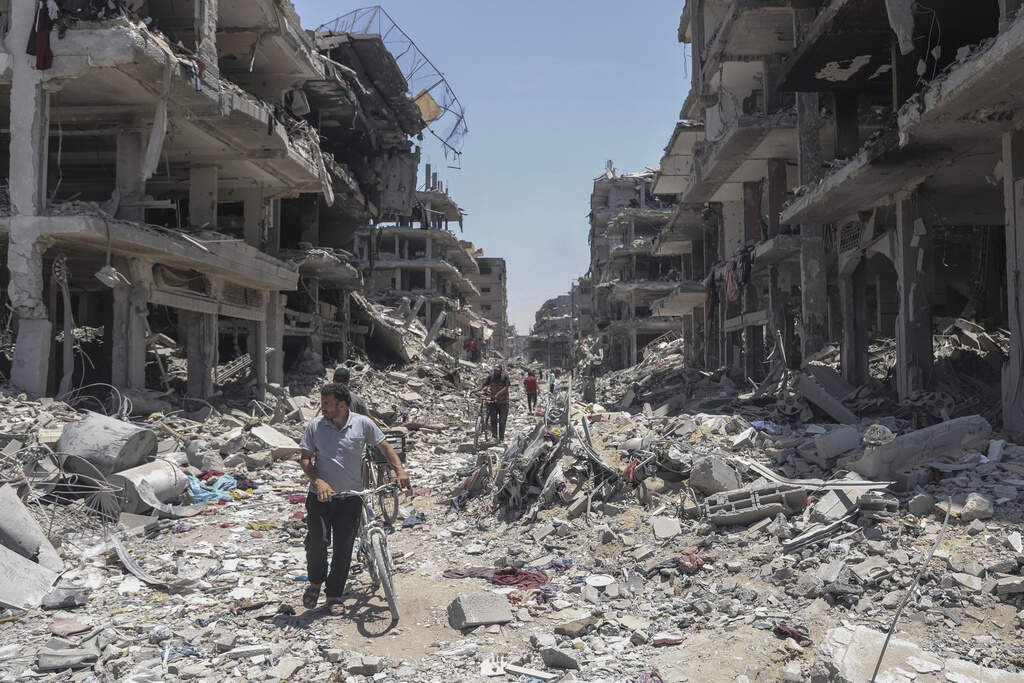
Humanitarian aid for Palestinians in northern Gaza is the lowest it's been in more than a year. People on the ground in Gaza share what, and who, could change the scale of civilian suffering.
Guests
Dahlia Scheindlin, Public opinion researcher and international political strategist. Columnist at Haaretz. Author of “The Crooked Timber of Democracy in Israel: Promise Unfulfilled."
Eran Etzion, Diplomat and strategist with more than 20 years of experience in senior government positions. Former head of policy planning at Israel's Ministry of Foreign Affairs and former deputy head of the National Security Council in the Prime Minister's office. Non-resident scholar at the Middle East Institute, a non-partisan think tank in Washington, D.C.
Deepmala Mahla, Chief Humanitarian Officer at CARE, a global humanitarian nonprofit. She visited Gaza in August.
Also Featured
Abeer Barakat, Gaza City resident. University lecturer. Teaches English at Gaza’s University College of Applied Sciences.
Transcript
Part I
MEGHNA CHAKRABARTI: Abeer Barakat lives in Gaza City, or what remains of it.
ABEER BARAKAT: I'm speechless. I'm speechless, really. But it's worse than anyone would imagine. It has taken our humanity away from us.
CHAKRABARTI: It has been 13 months since Hamas's attack on Israel. In response, the Israeli military launched an ongoing ground invasion and bombardment of Gaza.
Almost 75% of the buildings in Gaza City, the largest city in northern Gaza, have been reduced to rubble.
BARAKAT: We have no life in Gaza. What kind of life we have right now? There are no hospitals, no schools, no universities. No services, no kind of utilities. We are struggling to live day by day. I just look around me and I ask myself, how are we going to rebuild all of that?
CHAKRABARTI: Palestinians in Northern Gaza, where Abeer lives, are on the brink of famine. According to a United Nations backed report released earlier this month, Stéphane Dujarric, a UN spokesman, said yesterday that virtually no aid has been delivered to northern Gaza in the past 40 days, and that the territory is receiving, quote, nowhere near what we need to support more than 2 million Palestinians, end quote.
There was no immediate comment from the Israeli Defense Forces. According to reporting from the BBC, data from the Israeli military body that's responsible for humanitarian affairs in Gaza says that 472 aid trucks had entered northern Gaza via the Erez West crossing as of November 17th. But it does not specify whether any of that aid was allowed into besieged areas.
As for Abeer Barakat, she knows exactly how many days of food she has left. for her family. 13.
BARAKAT: Am I nervous? Yes, of course. I'm nervous. I'm not just nervous about if I'm going to find food for the next day. I'm nervous about all this kind of life that we are having, because this is, until now, something that we cannot fathom.
I still cannot believe. You can call this like I'm in denial or something, but I really cannot just believe this kind of life.
CHAKRABARTI: A little more than 13 months ago, Abeer Barakat was living a normal life. In fact, she says it was quite normal. Quite exceptional. She was teaching English at Gaza University's College of Applied Sciences, and was working towards her PhD.
BARAKAT: But not anymore. Right now, all our life is just revolving around providing food, looking for food. Bringing water, making a fire. It's like the basic things in life that no one should be worried about in this time, in this modern time. I feel like I've been, I've gone back to the Stone Age actually.
I do not think anymore about research. I do not think about progress anymore. All I think about is survival. And how to live day by day. That's all.
CHAKRABARTI: Abeer and her family have had to evacuate 14 times to different locations within Gaza City since the war began. Now she's with her husband, two of her children, ages 15 and 19, and her mother in law.
Her other two children were able to flee to Egypt just before the border crossing was closed. Abeer currently lives in a partially destroyed house in the center of Gaza City. It's the home of a friend who fled south, and it sits just a 10-minute drive from the Israeli ground invasion.
BARAKAT: Nobody feels safe, actually, because you don't know when the next strike will be, if they are going to have an aerial strike in the area where you are right now.
Or if they are targeting a person that is passing by you in the street or not. So they have all kinds of targets, all kinds of false targets, I will call it, because they kill without any kind of accountability, they kill anybody and everybody and they target every place, and they have all these kinds of allegations that this is a military place.
And this is so on and so forth. So no one feels safe.
CHAKRABARTI: There is no electricity, although Abeer considers herself lucky because she has been able to acquire two solar panels. When the sun is out, they have power. As for water, she buys it from trucks in the streets, and she says the city occasionally has been able to run water through parts of the system, but it's infrequent and what comes out of the pipes is not desalinated.
BARAKAT: Try to be as conservative with the water as possible because we're not, we don't have a lot of water. We need this water for cooking, drinking, washing the clothes, washing the dishes and of course, having, washing ourselves. I can't say having a shower, because we don't have the privilege, this privilege anymore.
CHAKRABARTI: And as you heard earlier, Abeer says she's trying to do her best to stretch a 13-day supply of food as far as she can.
BARAKAT: I keep them organized. I try to, from day to day, to change the kind of canned food we eat because we don't have a lot of options. We only have pasta, white beans, green beans, brown beans.
So it's all like beans and beans, that's all. So when I want to make, I just, if I, if we eat pasta today, then tomorrow it will be green beans. And then the next day it will be white beans. So my children would just ask me, what are you going to cook today? And I tell them, okay, you pick.
CHAKRABARTI: Fresh produce like onions, eggplants, and potatoes are sometimes available, but at a very high price.
BARAKAT: For example, in the past. You would buy potatoes, which are planted in Gaza, three to five kilos with only four or three shekels, something like this, very, it's one dollar. Now, if I want to buy one kilo of potatoes, it costs 1,000 shekels. It's something like thirty dollars. That's very expensive.
So would you want to have a like additional potatoes? It's a fantasy right now.
CHAKRABARTI: Almost 44,000 Palestinians have died in Gaza since October of last year, according to the territory's health ministry. The number could be higher. In May, Palestinian civil defense authorities estimated that 10,000 people could be buried under the rubble of Gaza's destroyed buildings.
And those people are not included in the health ministry's official casualty numbers. Abeer's father-in-law has died. Her brother in law's family is also dead, and her own brother, and his two children.
BARAKAT: My father-in-law just said, I don't want us to be in one place. Because if, God forbid, any, we had any kind of attack on the building, I don't want all the family to be wiped out.
So he wanted us to be scattered. So every one of us, every one of my brothers in law, we find a place and we just got scattered until one of my brother-in-law's family, they were killed when there was an attack on the building, and I have lost my brother just last week. I still cannot forget the image of his tent being burned while he is in it with his little angels, little seven- and four-year-old children.
The whole destruction around you is unimaginable. And I don't know how the occupation is getting away with it and how some hypocrites, like you as hypocrites, who actually say that Israel didn't commit a genocide. Or that that Israel hasn't done something that crossed the limits of the international law or so on and so forth.
I think whoever is lying to the people and issuing reports like that, they are lying to themselves. I'm sure that these liars will be judged by the history.
CHAKRABARTI: Israel has issued multiple mass evacuation orders across Gaza over the past many months. This summer, the UN Office for the Coordination of Humanitarian Affairs estimated that 89% of the Gaza Strip was under some kind of evacuation order.
Through all that, though, Abeer says she refuses to leave.
BARAKAT: This is my land. Why would I leave it? My grandmother and my grandfather, they made the biggest mistake in 1948 when they left Jaffa. When they were scared, and they ran for their life with their children. I'm not making that mistake again.
CHAKRABARTI: And although she plans to stay, Abeer says on most days, she doesn't often leave her home.
BARAKAT: There are two buildings just next to me where the bodies of the killed people inside them were not retrieved. So every time I just pass these buildings, I just cry, because I know that these people deserve a dignified burial, not to be just buried under the rubble and their loved ones cannot extract them.
I think about them every day and every night. So it's really agonizing to go away and to go out. I try and avoid not to go out frequently, because I don't want to add to my broken psychology anymore.
CHAKRABARTI: The Israeli military says its current offensive in northern Gaza is targeting regrouping Hamas fighters.
Last month, Israel's parliament voted to ban operations of the UN Agency for Palestinian Refugees, the main humanitarian aid agency working in Gaza. That legislation is set to go into effect in two months. Abeer is terrified for her future and her family's. But she says, she's lucky. She has a roof over her head for now, unlike her parents and brother, who live in a refugee camp down south.
BARAKAT: The other day, my brother told me that my father got cold to the extent that he couldn't go to the toilet in time. My father is a senior citizen. He's about 80 years old. He was supposed to be resting in his home after long years of working, he's supposed to have a dignified retirement.
But now he's staying in a tent and he's very sick and he has nothing right now. So imagine, it's not only my father. Imagine every person in Gaza is like that. We worked all our years to provide for ourselves good retirement years, but we have lost everything.
CHAKRABARTI: Abeer Barakat. She's in Gaza City. We'll hear more from her later on in the show. When we come back, we'll talk in depth about who, what, and how the scale of civilian suffering in Gaza is.
Part II
CHAKRABARTI: Today we are talking about who and what could reduce the scale of civilian suffering of Palestinians in Gaza. And joining me now from Tel Aviv is Dahlia Scheindlin. She's a public opinion researcher and international political strategist, a columnist at Haaretz as well, and author of The Crooked Timber of Democracy in Israel: Promise Unfulfilled.
Dahlia, welcome back to On Point.
DAHLIA SCHEINDLIN: Thanks for having me.
CHAKRABARTI: So I want to talk about how the question of the Israeli government's sense of how to achieve Israel's security, factors into this in a moment. But leaning on your public opinion researcher experience here, is there any discussion in Israeli public life, in the Israeli media, about Palestinian civilians in Gaza right now?
SCHEINDLIN: There's not a lot relative to what in the rest of the world, I would say that in most other places in the world, the main topic of conversation with regards to the war is the level of civilian suffering.
And that even includes the American government, which, as about a month ago, sent a letter from the Secretary of State and the Secretary of Defense telling Israel that it must ease the humanitarian situation in Gaza, or face restrictions under American law for weapons exports. It generated only a little bit of discussion, I would say, within the Israeli public. I think mostly the concern about whether America would limit its weapons export.
And as we know, after a month, America, the State Department decided that it was convinced that Israel was doing enough to ease up on the humanitarian situation. There has been a big gap with what aid organizations, international aid organizations have found in terms of the very, very limited amount of humanitarian aid getting through.
But I would say the Israeli public is not significantly focused on the issue. I don't want to portray that nobody thinks about it at all. I think that if people do think about it, they think it's an unfortunate but necessary consequence of the war. But you have to realize that the environment among the Israeli public is very consumed with what they are going through, starting with October 7th and the continued situation of the hostages who have not gotten back losses of soldiers and civilians.
We have civilian deaths in Israel. Certainly, just yesterday, an Arab Israeli citizen ... was killed by rocket fire from Lebanon or drone fire, actually. So there are ongoing issues in Israeli life that keep Israelis very focused on this. In addition to, I would say, pretty limited media coverage of the civilian suffering in Gaza.
And that's a reality, even though I don't think anybody should claim they can't know the information, even if it's not covered on television, because every Israeli has a cell phone.
CHAKRABARTI: Yeah. Just today, I believe, or just very recently, Prime Minister Netanyahu was in Gaza, right? He visited the Netzarim Corridor that runs the width of the Gaza Strip. And I see here in a report from the Times of Israel that Prime Minister Netanyahu noted that he says that the IDF has achieved, quote, excellent results toward the goal that the IDF has in northern Gaza, that Hamas will not rule Gaza, that the IDF is destroying Hamas's military capabilities in Gaza, particularly northern Gaza.
So that is the military strategy right now for what's happening in Gaza City. But then how does what we're seeing about the fate of the civilians, like Abeer, in Gaza City, factor into that? Because I'm also seeing that they're being told they have to go somewhere.
So can you help us sort that through, Dahlia?
SCHEINDLIN: I'd like to help you if the government was being clearer about it. It's one thing to say that they've achieved the military aims. The military aims as portrayed by the Prime Minister tend to be total destruction of Hamas, its governing and military capabilities. But there is evidence that, as you pointed out, that the policy and the army on the ground is clearing out northern Gaza in such an extensive way that if you combine that with statements from senior ministers in the Israeli government, it looks very much like there are voices advocating openly for annexation of Gaza, possibly starting in the north and rebuilding Jewish settlements.
Now that sounds like an extreme position, but these are positions that are being outlined by senior ministers in the Israeli government. When Netanyahu says, Hamas will not rule Northern Gaza or in Gaza in general. That may sound comforting to Israelis, but the fact is that without a plan for what happens afterwards, without ruling out that Israel permanently occupies Gaza, it's hard to think of what he does have in mind.
Of course, he's long since ruled out that the Palestinian authority would come in and govern. There has not been any significant talk of an international force or intervention. Even though that's something that's been in the air, but there's no plan towards getting there, since any sort of international intervention is very unlikely unless Israel commits to a pathway towards Palestinian statehood, which the prime minister has explicitly rejected.
And so I'd like to be able to say there is a plan for eventual stabilization and a day after. But right now there really isn't anything that the government has been willing to articulate, therefore we're left to judge based on piecing together what some of the voices in the government have said, and what we hear is reportedly is going on the ground, which, as you point out, is such extensive destruction of civilian infrastructure, attacks on civilians or evacuation of civilians that it looks like there is a sort of preparation for not letting them back.
CHAKRABARTI: I want to be clear about what some of the things that have been said, that at least we've heard. I heard reported and that earlier this month, Dhalia, as you well know, the IDF's Brigadier General Itzik Cohen told Israeli reporters, I believe, that there would be, quote, no return for Palestinians to their homes in northern Gaza, and that the IDF was getting close to a complete evacuation of all Palestinians from that area.
I wonder if, again, thinking about not just the military activity, but the vast reduction in aid that's entering these areas, can that reduction of aid be seen as part and parcel of the efforts to force the evacuation of Palestinians completely out of northern Gaza? I think we have to see it like that.
That is basically what's happened on the ground. Evacuation orders are given, the reduction of aid has been extremely severe. Just to give people some numbers. Before this war, hundreds, I think, between 400 and 500 trucks going, were going into Gaza every day. They have, that's gone down to a bare minimum.
The U.S. required, and it's in the letter from a month ago, required Israel to allow 50 trucks a day, in the current situation in Gaza, which is drastically worse. And aid organizations say that barely an average of over just over 40 trucks a day are actually getting in. We don't even, there are lots of reports that in the northernmost government of Gaza, practically nothing is getting in.
And so it's with the evacuation partners. I think the main question remaining, again, is whether that's considered part of a temporary military strategy for the IDF to accomplish those rather amorphous goals of total victory over Hamas, both in the north and everywhere in Gaza, and then some vision for stabilization that allows them back.
But like I've said before, we have no evidence coming from the government or on the ground that there is any preparation for aligning the blocks. So we have to take all these possibilities into account. There's a reason why these goals are not being articulated very significantly or why we're not seeing plans put into place.
For what happens after that. And just to follow up, the IDF, after Cohen's remarks, did release a statement or a spokesman said that Cohen's remarks had been quote, taken out of context and did not reflect the IDF's objectives or values. Dahlia, stand by for just a moment, because I'd like to bring Eran Etzion into the conversation.
He's a diplomat and strategist with more than 20 years of experience in senior government positions and was head of policy planning at Israel's Ministry of Foreign Affairs, and former deputy head of the National Security Council in the Prime Minister's Office. Eran, welcome to On Point.
ERAN ETZION: Hello. Hello. Very good to be here. Thanks for having me.
CHAKRABARTI: Yeah, and by the way, I just want to let listeners know that a little bit later in the show we will be hearing from an aid worker as well, but Eran, again, I'm trying to piece together the facts on the ground as they are, regarding what civilians in Gaza are enduring and what Israel's strategy is, particularly in northern Gaza right now.
There's reporting about a so-called generals plan. Can you tell us a little bit about that?
ETZION: Yeah, sure. First of all, we have to say that we don't know. I don't know. And I think certainly the Israeli public in general doesn't know actually what's going on. And there is a concerted effort. There has been a concerted effort from the very early on in the war.
And throughout and more so even in the last few months, to conceal and obfuscate and make sure, at least as far as the government and the IDF are concerned, that there is no flow of information in terms of what's actually going on the ground. Some of it is guided, as I said, by the government.
Some of it is unfortunately voluntary by the Israeli media, that essentially decided, collectively, somehow. Not that there isn't a collective forum of decision making for the entire Israeli media, but the outcome is that there is no flow of information, and the Israeli public by and large is clueless regarding what's going on.
And those of us who are trying very hard to actually find some of the facts, as you just said, and piece it together, are resorting to also all sorts of improvisations and trying to follow certain individuals and so on, but it's difficult. So we have to acknowledge that we don't have, I don't have anything close to full information in terms of what's going on.
Regarding the so-called General's Plan, there is such a plan that was pieced together by a number of respected former generals. One of them I know personally and worked with, and I have a lot of appreciation for, Giora Eiland. But actually, he denies any connection between his original plan and what is actually going on the ground, but essentially, and from very early on in this plan, it was a mix of security experts such as Eiland and ideologues.
Some of which are under U.S. sanctions for having blocked convoys of humanitarian aid to Gaza. These are far right extremists from the settlement movements, whose names, at least some of their names, are known to the American government and therefore they were sanctioned. So essentially, what the plan, the original plan, again, from the security perspective, calls for is implementing a siege on Northern Gaza, that Eiland originally claimed is actually according to international law, and he's basing himself on a certain manual of the American army that allows for certain situations, allows for such a siege designed to evacuate noninvolved individuals, the entire civilian population, from a certain designated area.
In order to leave just terrorists behind, and then the besieging force enters the evacuated area and takes care of the terrorists, and theoretically allows the population to return. Now according to Eiland, this was supposed to be beyond the immediate utility of capturing more and more terrorists, killing and capturing more and more terrorists.
The utility that he saw was using this as a leverage. Towards a hostage deal. Leverage, both in terms of the evacuated area and the evacuated population, that would theoretically put more pressure on Hamas. But of course, according even to that manual that he quotes, and according to international law, according to most experts that I've heard that analyzed the subject.
If first of all, there is such possibility of implementing a siege. But it has to be very targeted and focused, has to be limited in time, and the population has to have the, first of all, the conditions in terms of humanitarian conditions, shelter, food, sanitary conditions and so on in the place into which they are evacuated.
And of course, they must be allowed to come back. And as you said before, there were reports and even quotes from certain IDF officials, a certain one person that you just quoted again that said, they will not be allowed to return. And so far, what we're seeing is that there is this massive evacuation for a protracted period of time.
There are no sanitary or humanitarian conditions guaranteed for the evacuees by any stretch of the imagination. Adequate conditions, it's anything but. And as Dahlia said before, I listened to some of the conversation. It appears more and more that actually there is a hidden agenda, which is not military, but political, strategic, which is to evacuate the area from all its population and level it in terms of existing structures, and build the structure and the conditions for renewed settlement in Gaza.
CHAKRABARTI: Eran, hang on for just a second, because Dahlia, on that point, I want to turn to you, because overarching all of these important details is the assertion by the Israeli government that its actions are for the long term benefit of Israeli security. And I just wonder if what you're seeing and understanding at this point, in terms of what is happening as far as we can know in Northern Gaza, is it not a situation in which generations of young Palestinians now are going to have the utter destruction of Northern Gaza in their hearts and minds for a long time, and that therefore Israeli security is actually potentially weakened in the future?
I just don't understand how this makes Israel a safer and more secure place.
SCHEINDLIN: I would not only agree with you about the long term future, because, and this is something that is rather widely discussed in Israeli commentary and general conversations. There is a debate within political analysts and military analysts about whether this vast level of destruction is simply a recruitment tool for Hamas.
And we even hear reports about Hamas continuing to recruit during this war to make up for its losses of fighters. I think also, in the immediate term, there's another factor, which is that with all that debate over humanitarian aid, we don't really have any sense of who is supposed to do humanitarian aid.
The Israeli government has, at various times, or again, figures within the Israeli government, particularly the ultra nationalist, far right, very extremist minister, Bezalel Smotrich, has been advocating for the IDF to take over humanitarian aid. He says that will be the basis for the establishment of a military government.
Why do I think that ultimately this is related to the question of Israeli security? Because that's one step towards the annexation in general, or I shouldn't say annexation, but at least it's one step towards the occupation and more permanent sense of Gaza and possibly future annexation. With essentially, a furious and impoverished and miserable population under the control of the israeli army in a permanent sense, and I think that it will immediately lead to very immediate threats to israeli security.
There will be a kind of constant insurgency. If the israeli military is the main force on the ground not only fighting this battle. But ultimately laying the groundwork for a military occupation. I think the Palestinians in gaza know exactly where that will go, and there will be an insurgent, an insurgency, I would say right away and continuing, it will be the outgrowth of this war in a more immediate sense.
I don't think we even have to look into the longer term, but so we can also judge from history going back to some of the original reasons why Israel decided to leave. Or at least dismantle its settlements and its Army presence from within Gaza in 2005. Partly it was because of those kinds of security.
Part III
CHAKRABARTI: In a moment we're going to hear from the representative of a humanitarian organization that has been trying to get aid into Gaza. But I want to just return to Abeer Barakat who lives in Gaza City. And here's a little bit more about what she has said about what her life has been like in this past year.
BARAKAT: Although we have lost of lost a lot from ourselves, we have lost our properties, we have lost our jobs, our security, everything. We have many losses that we couldn't, you know, we stopped counting them. But it's only this faith in God that is keeping ourselves sane, actually. If I have lost my faith, I wonder if I would take it anymore, if I would be able to take it anymore or not.
CHAKRABARTI: Abeer tells us that she thinks not only about what's been done to Gaza City, but also what's been said about Gazans. Earlier this month, Israeli Prime Minister Benjamin Netanyahu fired Defense Minister Yoav Gallant. The two men had internal disputes over the fate of Israelis that are still being held hostage and over whether ultra-orthodox Israelis should serve in the military.
But regarding Gaza, Gallant has been unyielding. Last year, he said, "We are fighting human animals," when referring to Hamas. He also has warned Hezbollah in Lebanon that Israel would return Lebanon "to the Stone Age."
Now, Abeer is a civilian living in Gaza. She says that Stone Age fate has befallen her.
BARAKAT: He actually made us go way back to the Stone Age. We, it was a time that even our grandparents didn't live the same way that we are living. I feel like I'm living in year 1800. And when the occupation said that we are human animals, actually he made us and he humiliated us to the way that he wanted us to live like animals.
But I would tell him we are not animals. We are human beings. We are dignified. We have more dignity that anyone in the world would imagine or have. Because when I tell you that I'm cooking on woodfire, at the beginning, I thought of it as a humiliation. But after that, I'm sure that I'm proving to the occupation that I'm still living on this land. I'm still using the resources of this land to stay here.
Yes, I'm cooking on wood fire and I'm collecting food. I'm collecting water. But at the same time, I've come back to my original role, which is to be an educator and to be a researcher. So, whatever they do, we are still dignified because we are the true owners and the rightful owners of this land.
CHAKRABARTI: For now, Abeer tells us she does try to find joy in little things like the few plants she has in her yard, the cat she recently rescued and the time she is able to talk with her family and friends in southern Gaza and abroad.
BARAKAT: Me and my friends, every time we talk to each other, we keep telling ourselves that now we are on survival mode. Once the war ends, we will start the mourning mode, which means, you know, having this kind of mourning for all our loved ones, friends. We will find ourselves, you know, getting in this state of, you know, grief. Grief for all the ones we have lost and we didn't know anything about them.
Then we will try to think, how are we going to continue with our lives? We will stand — I'm sure that we will stand still and look around us and say to ourselves, "From where should I start?"
CHAKRABARTI: That's Abeer Barakat. She's in Gaza City.
Well, Deepmala Mahla joins us now. Deepmala is chief humanitarian officer at CARE International, and she visited Gaza in August. Deepmala, welcome to On Point.
DEEPMALA MAHLA: Hello. Happy to be here.
CHAKRABARTI: Can you tell us not just what you saw in August, but what your colleagues are telling you now about the state of need of Palestinians, particularly in Northern Gaza? Because as I referenced at the top of the show, the United Nations says that Gazans in the North are on the brink of famine.
MAHLA: I mean, absolutely. What I have seen in Gaza and what I have been hearing from my colleagues, partners, friends in Gaza, the living condition's unbearable, unacceptable and unimaginable. Since this started in October of 2023, every day, I thought, "This is as worse as it can get." And I was wrong every single day. Because it got worse and worse.
What I've been hearing from our partners on the ground, whenever we are able to contact them because communication is also very patchy, is that since October there virtually we have been able to take no aid to the northern part of Gaza. Our ability to take and distribute humanitarian aid in the Gaza Strip has been the lowest since these 14 months.
And all this is happening when we know that people are actually starving --
CHAKRABARTI: Deepmala? We're going to get her line back. She's in Bangkok, Thailand right now.
Eran, let me turn back to you here. Again, I'm just trying to seek out, as you mentioned earlier, some concrete facts. I mean, we're talking about aid organizations, even the UN, saying that almost zero aid has been entering Gaza, northern Gaza, in the past 40-plus days.
I mean, can you help us understand what — if that aid were to get in, how would it get in? Where would it get in? Is there any indication from the Israeli government that they are willing to sort of change their stance on this incredible bottleneck?
ETZION: I'll try to give you an answer, but I think there is something kind of preliminary that our listeners need to understand. And I'm relating to, you know, those of the listeners that were here, you know, 10, 15 minutes ago, where Dahlia was talking about, in response to your question about Israeli security, Israeli security concept, what is it that the Israeli government is trying to achieve?
CHAKRABARTI: Yes.
ETZION: I think it's very important to try and kind of deliver the message to the listeners that as far as this Israeli government is concerned, and unfortunately, that's also true about a large number of Israelis after October 7th, when they think about, they think and act about Israel's national security, they separate between security in kind of the bare-bones sense, in other words, making sure that there is no concrete threat launched from Gaza against Israel, not by way of rockets and missiles and not by way of terrorists crossing like they did in October 7th and doing the atrocities, committing the atrocities that they did.
So the thinking is how do we make sure that not only in the immediate present, but also not only even in the short term, but in the long term, we, Israel, make sure that no conditions — first of all, any existing threat is totally eliminated. And then we create the conditions that makes sure that such a threat will not reemerge. Okay?
CHAKRABARTI: Mm-hmm.
ETZION: And that's obviously very difficult. All of this is very much focused on the terrorists and potential terrorists. And it neglects, either consciously or not, the entire humanitarian aspect. Okay? It's not — the thinking is not about the 2.3 miserable and largely innocent Gazans --
CHAKRABARTI: Million, yes.
ETZION: It's more about the few tens of thousands, maybe hundreds of thousands, that are either active Hamas terrorists or active supporters of Hamas terrorists. And the focus is on them. And admittedly, there's a lot of collateral damage, with or without quotation marks, but this is the way it is looked upon, certainly by the government. But also by large parts of the Israeli population. So it's not a coincidence that there is no concrete planning for humanitarian assistance.
CHAKRABARTI: Eran, may I just step in here? Because I absolutely hear what you're saying. So let me just drive a little more forcefully to a point. I have seen you quoted as saying then this plan or whatever the Israeli military and government is carrying out right now in northern Gaza, I've seen you quoted as saying it is a war crime. Is it?
ETZION: That's not the exact quote, actually. I did say that it might become or constitute or include war crimes. And I hope it doesn't, but I specifically said, and I will say it again, that any Israeli soldier or officer that is asked to perform any act that might constitute a war crime, must refuse to do it. And this is actually Israeli law and the supreme court judgment that was made back in 1956.
And it's part of the old Israeli ethos and part of the IDF commands and part of the education of every soldier. I was a soldier in the IDF, in the combat unit. And that was part of my education. You know, if you're asked to do something on over which a "black flag" hangs, in other words, it's clear and present war crime or, a crime period, you're not supposed to do it. And that should be very clear.
Unfortunately, because of what I said earlier, and because of the, you know, scope, scale of the atrocities of the massacre of the victims and of the 14 months of war, which is the longest and gravest in our history, a lot of those norms have been eroded and a lot of what was kind of common ethos and understanding, either explicit or implicit, has been eroded. That's why I called for kind of the re-sharpening and reintroduction of these norms.
CHAKRABARTI: Yes.
ETZION: And I do hope that, you know, the situation, first of all, that the war will end quickly. And secondly, that obviously no war crimes are committed and that the war plans and the so called day-after plans of this government or the next government will be such that, again, they will, first of all, create the conditions to eliminate any future threat, but also create the conditions for long term peace and prosperity, not only for us Israelis, but also for Gazans.
CHAKRABARTI: Well, Eran Etzion, former head of policy planning at Israel's Ministry of Foreign Affairs, and currently a non-resident scholar at the Middle East Institute, Eran, thank you so much for joining us.
ETZION: Thank you.
CHAKRABARTI: We have — I believe we have Deepmala Mahla with CARE International back on the line. Deepmala, are you there?
MAHLA: I'm very much there.
CHAKRABARTI: Okay. So, I wanted to give you another minute just to quickly describe what you and your colleagues have been seeing. But let me just add to that what are they saying is the most immediate need for Gazans right now?
MAHLA: The most immediate need without a shadow of doubt is a ceasefire. Because we are unable to save lives and alleviate suffering when there is constant bombardment. What I'm hearing from my colleagues and partners on the ground that the Israeli forces have actually intensified the bombing and there is currently starvation on the ground happening. Children are starving to death.
I'm hearing from our partners pregnant, injured women are braving bombs and bullets to reach the hospital, but they cannot get any help there or much help there because there aren't enough supplies. There aren't enough medical practitioners. And to deliver humanitarian aid, Meghna, we need humanitarian workers. We are being killed. We are being attacked. We are bleeding a thousand cuts. So I would say, let the humanitarian aid in. There is deliberate obstruction of humanitarian aid in Gaza, which is in violation of the international humanitarian law. This is now so urgent that it's --
CHAKRABARTI: Deepmala? (SIGH)
Well, we're going to try and get her back one more time. But in the interim, I will say that as we heard earlier, Prime Minister Benjamin Netanyahu, again, was in Gaza earlier, just yesterday, or actually just today, and talking about his view that the IDF's operations in northern Gaza have been going as planned. And the IDF denies that it's carrying out, they say they're denying that they're carrying out a surrender or starve campaign.
However, as you've been hearing both from Deepmala, who is chief humanitarian officer at CARE, her colleagues on the ground are saying that there are children already starving in Gaza. We have been focusing on northern Gaza, particularly Gaza City, where there's lots of video evidence coming out. And satellite analysis that three-quarters, three-quarters of the buildings there have been reduced to rubble.
Deepmala, I see we have you back and hopefully we can keep you back for at least another 90 seconds, which is all we have left. You were saying that there are already children starving. Is that true both in northern and southern Gaza?
MAHLA: Absolutely. Everywhere. Because, you know, food has been in shortage for 14 months now. We humanitarians have been calling the world's attention to it. And when people have been so hungry, they are starving.
Can we save lives only with food? No. Because between starvation and death, there is usually disease. And for that, we need hospitals. We need medical services. But hospitals are being bombed, attacked continuously. So, it is happening everywhere. And while all this is happening, let us remember women are still pregnant. Women are still delivering children in these conditions.
And let me end by saying that it may look like a complete breakdown of infrastructure. In my opinion, it is not a breakdown of infrastructure, it is a breakdown of humanity. It's a breakdown of commitment, which must be restored immediately.
CHAKRABARTI: Deepmala Mala is Chief Humanitarian Officer at CARE International. She's currently in Bangkok, Thailand. She visited Gaza in August. Deepmala, thank you so much for joining us.
MAHLA: Thanks for having me.
This program aired on November 20, 2024.