Support WBUR
Boston's Morning Newsletter
The wildest stats and numbers from Boston's 'Snowmageddon' winter of 2015
Editor's Note: This is an excerpt from WBUR's daily morning newsletter, WBUR Today. If you like what you read and want it in your inbox, sign up here.
Ten years ago today, we woke up to what some were calling “the Blizzard of 2015” — in the same way people in the 1920s referred to World War I as “The Great War.” As it turned out, the massive snowstorm was just the first of four in as many weeks, kicking off a historic, infamous, MBTA-upending winter. Boston would go on to get over 110 inches of snow that season, an all-time record.
And you might argue that wasn’t even the wildest number. Here’s a look back at some of the most remarkable statistics from the winter of 2015.
- Nearly 95 inches of that winter’s snow fell between Jan. 24 and Feb. 22, completely burying the previous snowfall record for a 30-day period, which had been just 58.8 inches. The unprecedented month included four consecutive weeks of storms that dropped between 16 and 24 inches. (Jan. 26-27, Feb. 2, Feb. 7-9 and Feb. 14-15). According to MassDOT, the state also set records for the snowiest 10-day, 15-day, 20-day and 40-day periods.
- Several central Massachusetts towns got a full three feet of snow from the Jan. 26-27 blizzard. Worcester came close, with 34.5 inches.
- All in all, MassDOT removed 17.5 billion cubic feet of snow from state roads. As the Boston Herald reported, that’s 40 times the volume of dirt excavated during the Big Dig.
- The state also dumped 600,000 tons of salt on the roads over the course of the winter, including 110,000 tons in Boston. (Where does all that salt come from? Mostly, Chile.)
- Boston spent over $40 million responding to the storms that winter, more than twice its annual snow removal budget. Statewide, the total costs racked up to $167 million.
- The snow removal effort took 700,000 collective hours of labor by MassDOT. In Boston, private plow drivers and city employees worked 211,000 hours responding to the storms. According to The Boston Globe, the city paid $6 million in snow-related overtime
- Boston Public Schools had a total of eight snow days, forcing the district to hold makeup days on Evacuation Day and Bunker Hill Day in order to wrap up by June 30.
- March 30: That’s how long it took the MBTA to fully restore service across the subway and commuter rail systems. After three full-system shutdowns, some above-ground branches of the Green and Red Line didn’t reopen for over a week after the fourth storm. (You’ll recall this rough diversion map.) Many riders were forced to brave multi-hour commutes and brutally long lines for shuttle buses, as crew manually dug out the tracks. Former WBUR host Jack Lepiarz explains why it got so bad here.
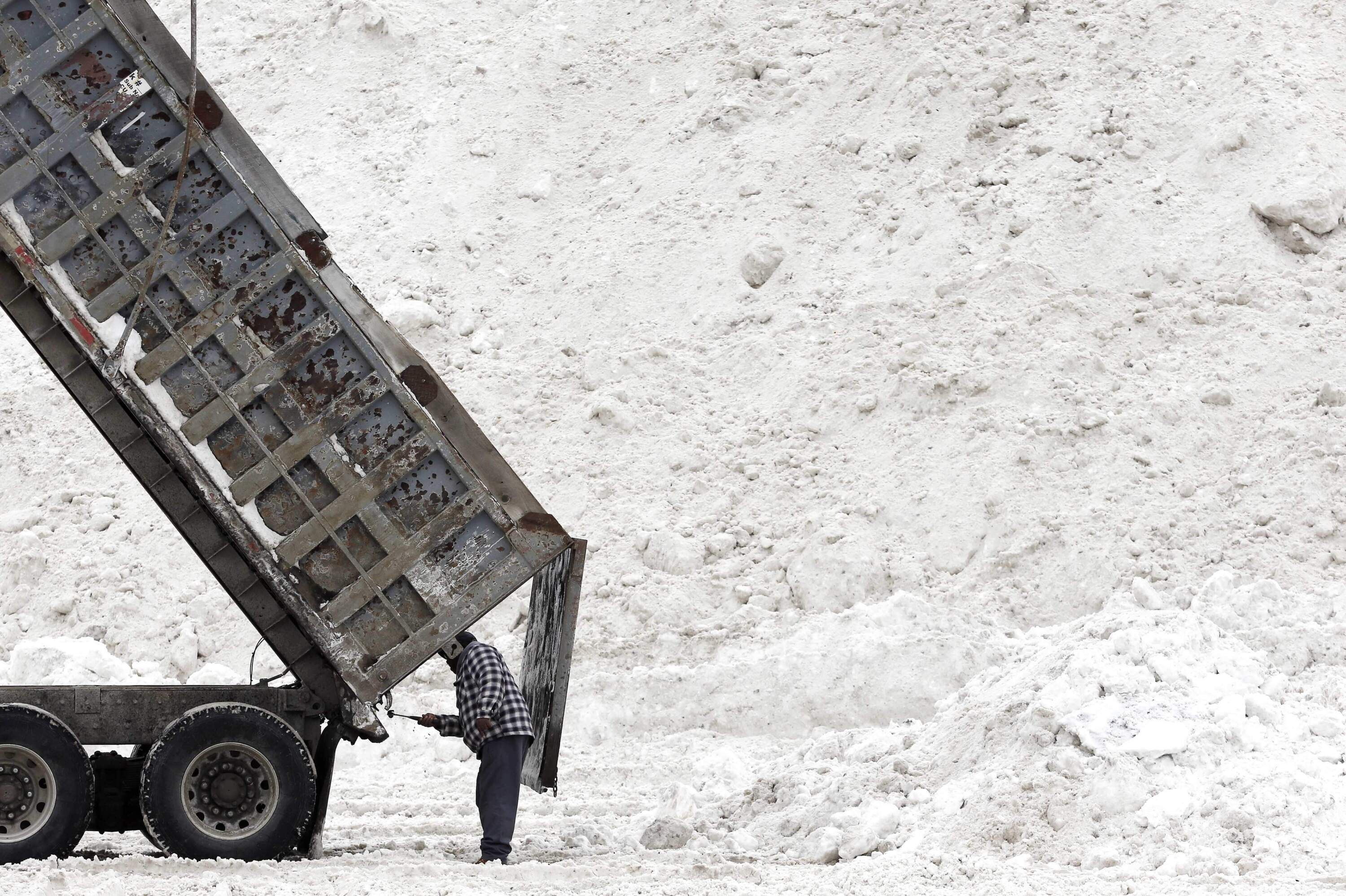
- July 14: That’s the day that the mountainous, garbage-filled snow pile in the Seaport finally melted away. At one point, the pile was 75 feet tall. (In case you’re wondering, the vacant lot where it sat is now home to a Vertex Pharmaceuticals office building.) Here’s a timelapse of its monthslong melt.